

Choosing Between Pre-trained APIs, AutoML, and Foundation Models
AI is no longer a pilot project; it is part of operational infrastructure. Yet research from BCG and IDC tells a sobering story: 74% of companies still struggle to scale AI value, and 88% of proof of concepts never reach production.
The problem is rarely the technology. It is choosing the wrong tool for the problem, starting with dirty data, or lacking the implementation expertise to close the gap between prototype and production. Google Cloud’s AI stack is genuinely powerful — but its breadth creates a real decision problem. This guide cuts through that.
THE THREE-TIER FRAMEWORK
Google’s own guidance is clear: start with the simplest tool that solves your problem, and only move up the stack when you need more.
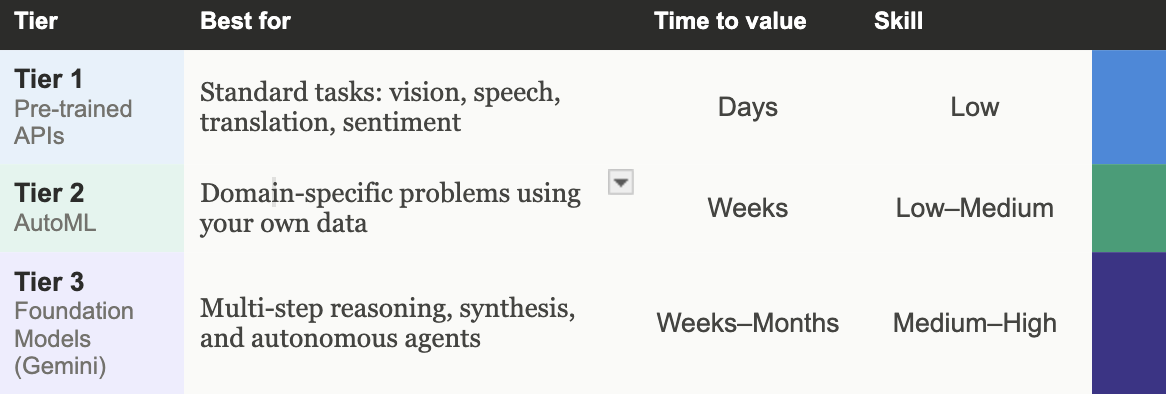
Each tier builds on the one below. Start at Tier 1 and move up only when your problem demands it.
TIER 1 — PRE-TRAINED APIS
Pre-trained APIs are Google’s off-the-shelf cognitive skills. You call the API, pass in your data, and get a structured result, no training required. They cover document extraction (Document AI), image and video analysis (Vision AI), natural language and sentiment (NLP API), speech transcription, and translation across 133 languages.
Use them when your use case is generic, you have no training data, and you want results in days. Document AI alone reduces administrative processing time by up to 70% for finance teams handling invoices and contracts.
Their limit: they are trained on general data. If your problem is specific to your products, defects, or industry terminology, accuracy will fall short, and that is when you move to Tier 2.
TIER 2 — AUTOML
AutoML bridges off-the-shelf AI and full custom development. You supply labelled examples from your own operations; Google Cloud handles the model architecture search, tuning, and training automatically — no ML code required. It works across images, tabular data, and text classification using your terminology.
The critical factor is data quality. Vertex AI recommends at least 1,000 labelled examples per category, with no single category less than 10% of the largest. McKinsey’s 2025 research found that 43% of organisations cite data readiness as their primary AI barrier, and that winning programmes allocate 50–70% of the project budget to data preparation rather than model training.
TIER 3 — FOUNDATION MODELS & AGENTS
The Gemini model family, accessed via Vertex AI’s Model Garden, which covers 200+ models, does not just classify or predict: it reasons across text, images, video, code, and structured data simultaneously. Gemini 2.5 Pro handles complex synthesis and long-context tasks; Gemini 2.5 Flash balances quality and speed at scale.
The defining shift in 2026 is agentic AI: systems that proactively plan, execute, and adapt across multi-step workflows without constant human input. Use cases include synthesising thousands of pages of contracts into a queryable knowledge base, customer concierge agents that guide purchases end-to-end, and SOC automation that reduces breach risk by up to 70%.
Move to Tier 3 when your problem requires reasoning across multiple sources, mixed modalities, or autonomous action. But be aware: token-based pricing, prompt engineering, and agent orchestration require careful architecture. Build migration plans from day one.
“Does a pre-trained API get you close enough? If yes, use it. If not, do you have proprietary data? If yes, AutoML. If your problem requires reasoning, synthesis, or autonomous action — that is Gemini.”
THE DECISION IN ONE QUESTION
Three questions narrow any AI problem to the right tool. Work through them in order — escalate only when the simpler tier falls short.

Start with the simplest option. Escalate only when required.
WHY 88% OF AI PILOTS DO NOT MAKE IT
The failure patterns are consistent across industries and geographies: wrong tool for the problem, poor data readiness, building for a sandbox rather than production, and attempting it without implementation expertise. The average cost of a failed AI pilot is estimated at $2.3M when you account for technology investment, personnel costs, and opportunity costs.

Sources: BCG, IDC, McKinsey 2025, Concentrix / Everest Group 2025.
The organisations that succeed share one trait: 63% use a hybrid model — combining internal capability with an experienced external partner — to bridge every layer of the stack simultaneously.
THE PAWA IT DIFFERENCE
As East Africa’s Google Cloud Premier Partner, Pawa IT has delivered 450+ enterprise AI implementations across 22 countries — including production systems handling 200,000+ daily requests.
Our four-phase approach: Assess (data readiness audit and use case prioritisation), Plan (architecture and cost modelling), Implement (agile build with MLOps from day one), Activate (production launch and continuous monitoring). We do not just deploy AI — we harden the data foundation it runs on.
The result: our clients avoid pilot purgatory and reach production AI that compounds business value over time.
THE BOTTOM LINE
Navigating the Google Cloud AI stack is about matching tool to problem — Pre-trained APIs for speed, AutoML for proprietary precision, Gemini for reasoning and autonomy — and then executing with the discipline that gets you from pilot to production. The technology is ready. The question is whether your implementation approach is.
EAST AFRICA’S GOOGLE CLOUD PREMIER AI PARTNER
Ready to move from pilot to production?
Talk to Pawa IT Solutions — we help organisations across 22 countries close the gap between prototype and production AI.
www.pawait.africa